01 Answer first
What equipment is included in a complete PET water bottling line?
The project may include water treatment and hygienic storage, PET bottle blowing or purchased-bottle handling, air conveying, rinsing-filling-capping, full-bottle conveyors, labeling, date or batch coding, inspection, secondary packing, compressors, cooling, controls and project services. Every item must still be identified as included, optional, buyer-side or open in the project quotation.
Current buyer search guide
How does a complete PET bottled water production line work?
A reliable PET line is a connected production system. Water, preforms, caps, labels and packing materials move through linked processes whose real capacities, utilities and control signals must agree.
| System stage | Primary job | Critical interface | Acceptance evidence |
|---|---|---|---|
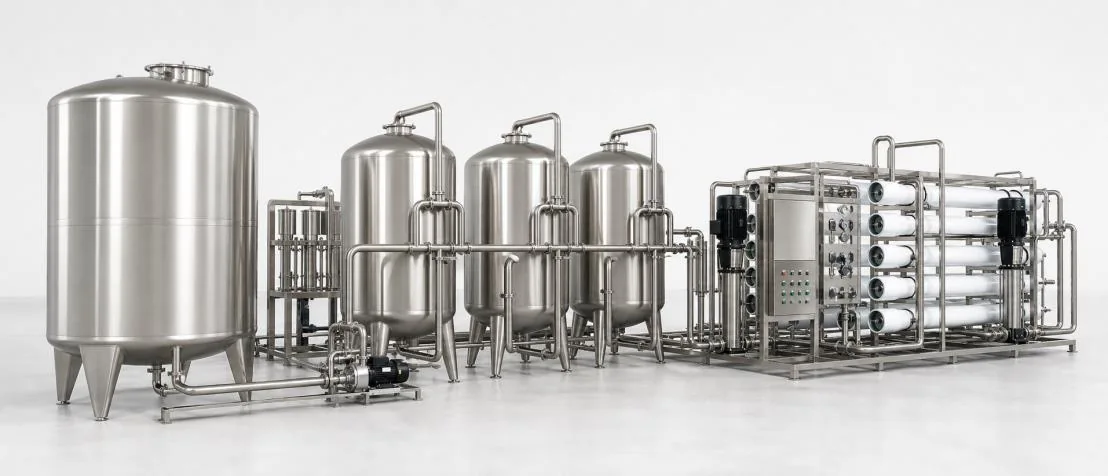
| Water preparation and storage | Create product water to the approved specification and supply it hygienically. | Source variability, treatment recovery, tank turnover and filler demand. | Water results, sanitation records, flow data and alarm checks. |
| Preform heating and bottle blowing | Produce stable bottles at the required format and practical rate. | Preform specification, high-pressure air, cooling, mold and bottle quality. | Bottle dimensions, weight, top load, leak results and sustained output. |
| Rinsing, filling and capping | Control the hygienic product-contact process and closure application. | Bottle transfer, product feed, cap quality, fill level and cleaning boundary. | Good-product count, fill and torque samples, downtime log and sanitation verification. |
| Labeling, coding and inspection | Apply saleable identification and remove defined defects. | Bottle geometry, label material, condensation, code content and reject logic. | Approved samples, readability checks, challenge tests and reject records. |
| Packing, conveying and pallet flow | Create stable saleable packs and move them without damaging bottles. | Accumulation, film or carton, pack pattern, compression and warehouse route. | Pack-quality samples, conveyor recovery tests and pallet stability results. |
| Utilities, controls and project services | Support every machine and turn the equipment chain into an operable plant. | Power, air, cooling, drainage, data, safety, spares, training and responsibilities. | Verified load list, interface sign-off, FAT/SAT records and handover dossier. |
A complete PET line should be accepted on defined good product under agreed materials, utilities and test conditions—not on the filler nameplate alone.
Buyer problem-to-decision map
PET-Line Questions That Connect Bottle Making to Packed Product
The complete line should control bottle, closure, label and pack compatibility across machine rates, transfers, utilities, quality checks and abnormal states.
Does a complete PET water bottling line include bottle blowing?
It can, but the scope must say whether bottles are made from preforms on site or received as empty containers. Each route has different equipment, utilities, storage, quality and interface requirements.
- Inputs needed
- Bottle and preform drawings and samples; SKU demand; supply-chain option; compressor and cooling availability; storage; bottle-quality and hygiene plan.
- Decision evidence
- Defined bottle-supply boundary, equipment list, utilities, quality checks, format parts, transfer interface and test conditions.
How are the blow molder and filler matched?
Match approved bottle conditions, sustainable rates, transfer and accumulation, controls, fault states, restart logic, format changes and utility stability—not only nominal machine speeds.
- Inputs needed
- Bottle formats and quality tolerances; rate curves; transfer distance; stop scenarios; buffer policy; signal list; compressor and cooling states.
- Decision evidence
- Interface-control document, line-state model, bottle trials, signal and recovery tests, trend and counter evidence, open-limitations record.
Can one PET line run several bottle and cap formats?
Only formats within the confirmed machine, mold, handling and quality windows should be committed. Each SKU needs controlled drawings or samples, change parts, setup parameters and representative acceptance evidence.
- Inputs needed
- Bottle, neck and cap specifications; labels and secondary packs; SKU volumes; changeover policy; preform and material data; required future formats.
- Decision evidence
- Approved format matrix, compatibility review, change-part list, setup and changeover method, sample and trial results, exclusions and expansion conditions.
Which downstream machines make the PET line complete?
Completeness follows the required sale unit and dispatch interface. Inspection, coding, labeling, bundle or carton packing, handles, conveyors, palletizing and wrapping should each be identified as automatic, manual, optional or excluded.
- Inputs needed
- Label and code requirements; pack recipes; pallet and distribution conditions; labor model; finished-goods route; quality and traceability rules.
- Decision evidence
- End-of-line process map, equipment and manual-task list, format matrix, pack samples, line balance, interface and acceptance schedule.
02 Where it fits
Position in the project journey
Complete-line definition - after product and package selection and before model, layout and utility freeze.
03 Buyer inputs
What the buyer should prepare
- Raw-water analysis, finished-water category and required monitoring basis
- PET bottle drawings, volumes, neck finish, cap, label and approved samples
- Saleable output by reference bottle, format mix and finished-pack pattern
- Factory dimensions, utility availability, destination and desired site services
04 Allot Tech and manufacturing-resource inputs
What should be clarified or provided
- Treatment, storage, bottle supply, filling and packing process boundary
- Full-line rating conditions, restrictions, accumulation and changeover basis
- Point-of-use electrical, air, cooling, water, drainage and control interfaces
- Approved equipment schedule, drawings, FAT method, documents and exclusions
Allot Tech coordinates requirement, quotation and project communication. Detailed engineering, manufacture, testing, documentation and confirmed service are performed by selected manufacturing resources according to the signed scope.
05 Technical scope
Questions and work to control
Choose Purchased Bottles or In-House PET Blowing
Purchased empty bottles reduce the internal blowing and high-pressure-air boundary but add supplier quality, storage and delivery dependencies. In-house blowing adds preforms, molds, heating, high-pressure and service air, cooling and bottle-transfer interfaces. Compare both routes on the same demand, quality and factory basis.
- Bottle demand and supplier continuity
- Preform, resin and approved bottle specification
- Compressed-air, cooling and electrical availability
- Empty-bottle storage or direct air-conveyor transfer
Match Water Preparation to the Product Basis
Treatment must follow the source-water report, finished-water target and local product rules. The catalog shows mechanical or multimedia filtration, activated carbon, softening, precision filtration, RO, ultrafiltration, ozone and UV as relevant modules—not as one mandatory universal train.
- Source quality and seasonal variation
- Required removals and finished-water limits
- Storage, recirculation and sanitation concept
- Qualified local and process review before release
Integrate Rinse, Fill, Cap and Bottle Transfer
The catalog presents XGF as a normal-pressure PET water washing-filling-capping 3-in-1 reference family with air-conveyor infeed and coordinated outfeed controls. This is a Catalog Reference; the current model, bottle range, rating, controls and materials require project confirmation.
- Bottle and neck handling at each transfer
- Product contact and sanitation requirements
- Cap specification, feeding and closure verification
- Buffer purpose and downstream stop response
Design Backward From the Finished Distribution Pack
Label technology, code location, bottle stability, bottles per bundle or case and dispatch handling determine downstream machine duty. The catalog identifies sleeve labeling, coding, shrink packing, case-packing and pallet-handling categories; the selected path must match approved materials and pack samples.
- Label material, application and inspection
- Readable batch or date code and record owner
- Pack pattern, film, tray or carton specification
- Discharge, pallet or warehouse interface
Buyer questions answered
Practical answers before you request a quotation
Does a complete PET line always include a bottle blower?
No. The plant can use purchased empty bottles or in-house blowing. The selected route and every auxiliary must have an explicit commercial status.
What is the capacity of a complete PET water line?
Capacity is project-specific and must use one reference bottle, pack, materials, utilities and acceptance basis. A filler catalog figure is not complete-line output.
Is reverse osmosis required for every PET water line?
No. Treatment follows actual source water, finished-water requirements and applicable product rules; a generic RO package should not be assumed.
Which utilities can bottle blowing add?
It can add high-pressure and service compressed air, cooling and electrical demand. The final equipment determines quality, pressure, flow, peak and connection requirements.
What should be tested before shipment?
Use an agreed FAT protocol covering available functions, approved bottles and materials, safety, interfaces, documents, deviations and the limits of factory testing.
06 Responsibility
Assign the owner before the work is due
Land, building and civil work, permits, import and customs, local taxes, site utilities, unloading, lifting, local labor, travel support and commissioning materials are not automatically included. Confirm every responsibility before order.
07 Common risks
What commonly creates avoidable uncertainty
- Filler nameplate speed is treated as accepted finished-line output
- Blower, filler and packer are rated on different bottle or pack conditions
- Compressors, cooling, conveyors or change parts are assumed included without written status
08 Acceptance or completion
How to know the stage is complete
The PET route is commercially defined when each machine uses the same reference package, all transfer and utility interfaces have owners, and FAT and site acceptance conditions distinguish catalog data from project commitments.
09 Required documents
Records that support the decision
- Product, raw-water and treated-water design basis
- Bottle, cap, label and finished-pack data sheets
- Source-to-pack equipment and interface schedule
- Line-balance, FAT and site-acceptance records
Evidence basis
Official references and project limits
These primary sources support the general planning principles used in this guide. The rules, evidence and responsible authority for the actual project country must still be confirmed locally.
Project-specific proposal input
Configure the PET line around the real bottle and finished pack
Provide the reference bottle, neck, cap, label, pack, required output and site utilities so blowing, filling and end-of-line interfaces can be reviewed together.
10 Next project step
Related guides and next project steps
Provide the reference bottle, neck, cap, label, pack, required output and site utilities so blowing, filling and end-of-line interfaces can be reviewed together.
Request PET Line Configuration
Turnkey scope is project-specific and is defined by the signed technical and commercial agreement.