01 Answer first
How do you choose a water treatment system for a bottling plant?
Define the raw-water condition and variation, finished-water target, legal product basis, required product-water flow and operating schedule. A qualified process review can then select justified pretreatment, membrane or filtration stages, disinfection, hygienic storage, distribution, monitoring, cleaning and reject or wastewater handling.
Buyer problem-to-decision map
Treatment-System Questions That Need Source-to-Product Evidence
Select a treatment train by documenting hazards and quality objectives, then verify capacity, utilities, residuals, controls and acceptance as one system.
How is a bottled-water treatment system selected?
Map the representative source-water conditions to the finished-water specification and product route, then select barriers and conditioning steps that can be monitored, maintained and accepted under the actual site constraints.
- Inputs needed
- Raw-water analysis and variation; finished requirements; source flow and continuity; local product and discharge rules; operator skills; utilities; maintenance access.
- Decision evidence
- Treatment design basis, hazard and objective map, process calculations or trials, equipment and control schedule, mass balance, assumptions and review record.
Is reverse osmosis always the safest treatment choice?
No treatment technology is automatically correct. RO can address selected dissolved constituents but creates pretreatment, concentrate, energy, cleaning and post-treatment duties that must fit the source and product case.
- Inputs needed
- Contaminant and mineral profile; microbial controls; product identity and sensory target; discharge route; energy and chemical supply; recovery and stability requirements.
- Decision evidence
- Technology comparison, removal and recovery basis, concentrate assessment, pilot or supplier evidence where needed, control plan and qualified approval.
What treatment capacity should be specified?
Work backward from product and cleaning demand over the operating calendar, then include treatment recovery, backwash or regeneration, sanitation, storage strategy, peak windows and justified redundancy.
- Inputs needed
- Saleable production plan; product-water demand; rinser and cleaning use; treatment yield by state; tank levels; source availability; maintenance and regeneration schedule.
- Decision evidence
- Time-based water balance, tank and pump operating logic, peak and average duties, bottleneck review, alarm response and representative acceptance test.
How should treatment performance be accepted?
Test against agreed inlet conditions, operating state, sampling method, output quantity and quality, recovery or waste basis, alarms and control responses. State limitations when the source or site conditions differ from the design basis.
- Inputs needed
- Approved raw and finished specifications; source conditions; sampling and laboratory plan; test duration and flow basis; chemical and utility status; deviation rules.
- Decision evidence
- Approved protocol, calibrated readings, laboratory results, mass-balance record, trends, deviation and retest log, and authorized release decision.
02 Where it fits
Position in the project journey
Water-process engineering - after representative sampling and before treatment equipment, utilities, tanks and filling interfaces are frozen.
03 Buyer inputs
What the buyer should prepare
- Representative raw-water report with source, sampling point, date, units and methods
- Finished-water target, product definition, market and qualified approval route
- Required product-water flow, operating hours, storage and future-demand cases
- Available feed, power, drainage, chemical handling, space, labor and discharge constraints
04 Allot Tech and manufacturing-resource inputs
What should be clarified or provided
- Contaminant or condition-to-treatment rationale and declared design envelope
- Equipment sequence, duty, materials, instruments, controls and redundancy status
- Water balance, backwash, concentrate, cleaning, chemical and waste interfaces
- Tank, distribution, sanitation, sampling, FAT, commissioning and documentation basis
Allot Tech coordinates requirement, quotation and project communication. Detailed engineering, manufacture, testing, documentation and confirmed service are performed by selected manufacturing resources according to the signed scope.
05 Technical scope
Questions and work to control
Build the Design Envelope From Representative Water Data
One laboratory snapshot may not describe seasonal or operating variation. Record the source, sampling point and condition, then identify values that control fouling, scaling, taste or odor, disinfection, materials and finished-water compliance. Unknown values should remain open, not become zero.
- Traceable sampling and laboratory report
- Expected minimum, normal and maximum conditions
- Qualified interpretation and open parameters
- Change-control plan when the source changes
Give Every Pretreatment Stage a Stated Purpose
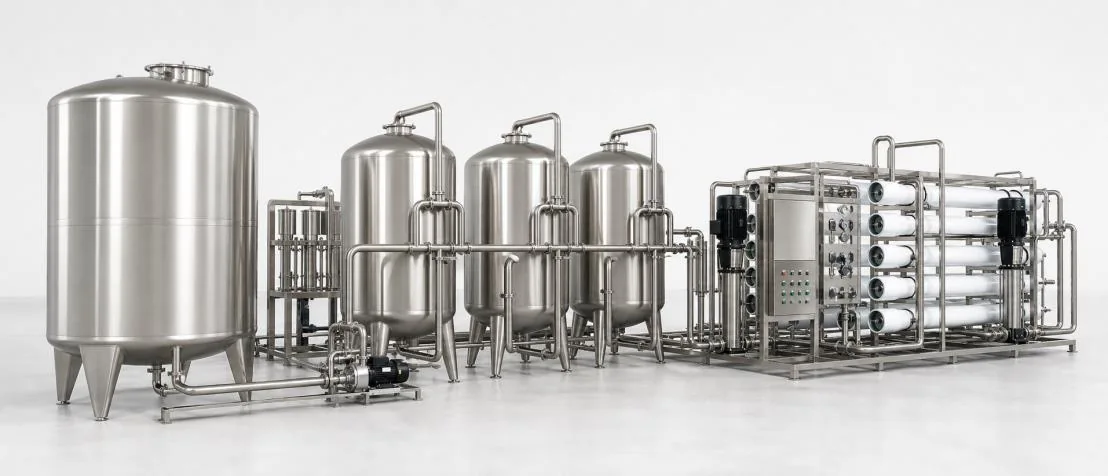
The catalog identifies multimedia or mechanical filtration, activated carbon, sodium-ion exchange and precision filtration. Project engineering should state what each selected stage removes or protects, its backwash or regeneration need, media or cartridge boundary and evidence of correct operation.
- Solids, turbidity and filter-loading objective
- Organic, odor or oxidant-control objective
- Hardness and scale-control decision
- Consumables, chemicals and waste responsibility
Choose RO, Ultrafiltration or Another Route Deliberately
RO and hollow-fiber ultrafiltration are separate catalog categories. RO may address dissolved constituents as part of a purified-water route; UF may be considered for appropriate mineral or spring-water applications. Neither selection follows from the domain keyword alone, and both require project confirmation.
- Required separation and finished-water target
- Effect on the intended product identity
- Feed protection and cleaning requirements
- Recovery, concentrate and operating strategy
Complete the System With Disinfection, Storage and Verification
Ozone, UV, oxidation or contact arrangements, terminal filtration, tanks and distribution should have stated purposes and operating evidence. Confirm material compatibility, contact or exposure basis where applicable, off-spec response, sampling points, sanitation and the filler-inlet condition.
- Disinfection objective and validation owner
- Hygienic tank, vent and distribution design
- Online instruments and laboratory checks
- Hold, divert, drain and release logic
Buyer questions answered
Practical answers before you request a quotation
Which water treatment system is best for a bottling plant?
There is no universal best train. The source analysis, finished-water target, product rules, operating demand and site constraints determine the suitable route.
Is reverse osmosis always necessary?
No. RO is one process option. Its need and design follow the required removals and product basis, not a generic bottled-water plant label.
What is the difference between RO and ultrafiltration?
They address different separation duties and operating conditions. A qualified process review should match technology to the actual feed and product objective.
Are ozone and UV interchangeable?
No assumption should be made. Their purpose, location, exposure or dose basis, materials, controls and verification differ and must be engineered.
Can catalog specifications be used to build the utility system?
No. Catalog data are references. Final electrical, water, air, drainage, chemical and control requirements must come from the confirmed project equipment.
06 Responsibility
Assign the owner before the work is due
Land, building and civil work, permits, import and customs, local taxes, site utilities, unloading, lifting, local labor, travel support and commissioning materials are not automatically included. Confirm every responsibility before order.
07 Common risks
What commonly creates avoidable uncertainty
- Old or nonrepresentative water data are treated as the final feed-water envelope
- Catalog modules are combined without a stated removal or protection objective
- Reject water, backwash, chemicals, consumables or membrane cleaning are omitted
- Treated-water storage and filler transfer remain outside the hygiene review
08 Acceptance or completion
How to know the stage is complete
Every treatment stage has a defined purpose, feed and product condition, operating and cleaning requirement, instrument or verification method, interface owner and project-specific acceptance basis.
09 Required documents
Records that support the decision
- Raw-water analysis and variability register
- Finished-water specification and treatment design basis
- Process flow, water balance and equipment schedule
- Utility, sanitation, monitoring and commissioning records
Evidence basis
Official references and project limits
These primary sources support the general planning principles used in this guide. The rules, evidence and responsible authority for the actual project country must still be confirmed locally.
Project-specific proposal input
Turn this decision into a reviewable project brief
Share the product, container, target output, destination and available site information. Unknown inputs can remain open for the first review.
10 Next project step
Related guides and next project steps
Share the product, container, target output, destination and available site information. Unknown inputs can remain open for the first review.
Explore this topic cluster
Turnkey scope is project-specific and is defined by the signed technical and commercial agreement.