01 Answer first
How should a purified-water treatment system be validated?
Define the representative feed-water range and finished-product requirements; identify each stage’s purpose and critical operating limits; qualify instruments, sampling and sanitation; run an approved protocol across stated conditions; compare recorded results with acceptance criteria; close deviations; and establish routine monitoring, release and revalidation controls.
02 Where it fits
Position in the project journey
Treatment qualification - after process design and before routine bottled-water production release.
03 Buyer inputs
What the buyer should prepare
- Representative feed-water data, variability and approved source status
- Finished purified-water specification and target-market requirements
- Laboratory methods, sampling authority, hold and release process
- Operating scenarios, sanitation approach and revalidation policy
04 Allot Tech and manufacturing-resource inputs
What should be clarified or provided
- Stage purposes, design conditions, controllable limits and expected outputs
- Instrument list, sample points, alarms, interlocks and data availability
- Startup, shutdown, flushing, cleaning and preservation instructions
- Validation support, documents, limitations and site-dependent requirements
Allot Tech coordinates requirement, quotation and project communication. Detailed engineering, manufacture, testing, documentation and confirmed service are performed by selected manufacturing resources according to the signed scope.
05 Technical scope
Questions and work to control
Validate Against a Defined Feed-Water Envelope
Use representative approved-source data and record seasonal or operating variability relevant to pretreatment and purification. If the test feed is easier than the declared design basis, state the limitation and do not extend conclusions without evidence.
- Approved source and sampling history
- Relevant minimum, typical and adverse conditions
- Pretreatment and membrane design dependencies
- Temporary test assumptions clearly identified
Link Every Stage to a Measurable Purpose
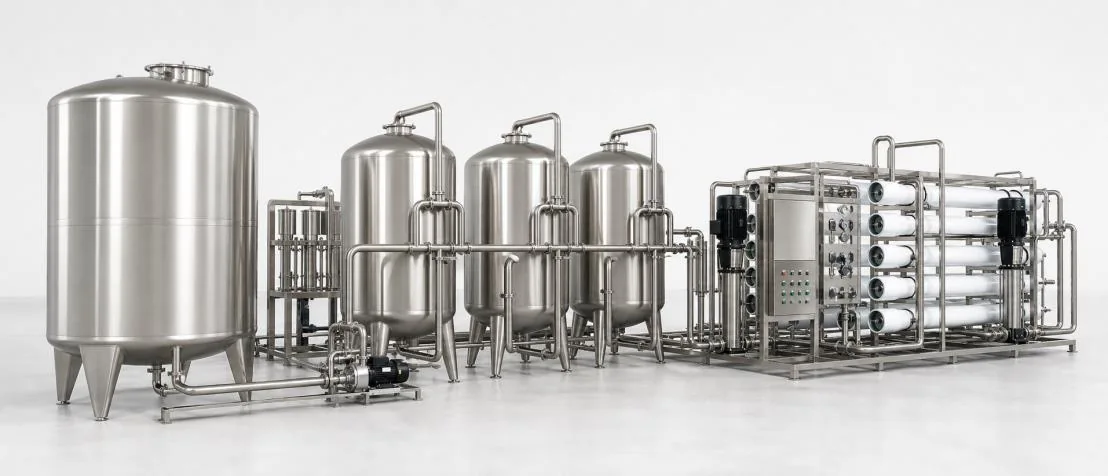
For filtration, carbon, softening, membrane, UV, ozone or other project-selected stages, define the specific objective, input condition, monitored parameter, alarm or action limit and downstream consequence. A generic train should not replace a validated process rationale.
- Stage objective and upstream dependency
- Critical operating and quality parameter
- Alarm, diversion or shutdown response
- Cleaning and restoration evidence
Translate the Study Into Routine Release
Validation is useful only when its proven conditions become recipes, procedures, calibration, sampling, trending and release rules. Define what happens after deviations, extended shutdowns, source changes, membrane work or sanitation changes.
- Approved operating window and records
- Routine sample and instrument review
- Product hold and release authority
- Deviation investigation and revalidation triggers
Buyer questions answered
Practical answers before you request a quotation
Does purified water always require reverse osmosis?
No universal equipment route should be assumed. The process follows source water, finished-product identity and applicable requirements.
Is one compliant sample enough to validate treatment?
No. The protocol should demonstrate the connected process under stated representative conditions and include operating evidence.
What happens when feed-water quality changes?
Assess the change against the validated envelope and use the approved hold, investigation, adjustment or revalidation process.
Can factory testing replace site validation?
No. Final source water, installed utilities, piping, laboratory and operating conditions normally require site evidence.
06 Responsibility
Assign the owner before the work is due
Land, building and civil work, permits, import and customs, local taxes, site utilities, unloading, lifting, local labor, travel support and commissioning materials are not automatically included. Confirm every responsibility before order.
07 Common risks
What commonly creates avoidable uncertainty
- Validation uses feed water that does not represent the approved operating envelope
- A single finished-water result is treated as proof of sustained process control
- Critical instruments or laboratory methods are not qualified before testing
- Routine operation permits conditions outside the demonstrated validation window
08 Acceptance or completion
How to know the stage is complete
The process is validated when approved testing under stated representative conditions meets finished-water and process criteria, instruments and methods are fit for their assigned use, deviations are resolved, and routine monitoring, release, sanitation and revalidation controls are authorized.
09 Required documents
Records that support the decision
- Feed-water envelope and finished-water specification
- Treatment validation protocol and approved acceptance criteria
- Raw operating data, sample results and deviation log
- Final report, routine-control and revalidation plan
Evidence basis
Official references and project limits
These primary sources support the general planning principles used in this guide. The rules, evidence and responsible authority for the actual project country must still be confirmed locally.
10 Next project step
Turn this decision into a reviewable project brief
Share the product, container, target output, destination and available site information. Unknown inputs can remain open for the first review.
Turnkey scope is project-specific and is defined by the signed technical and commercial agreement.