01 Answer first
What systems are used in a purified-water bottling plant?
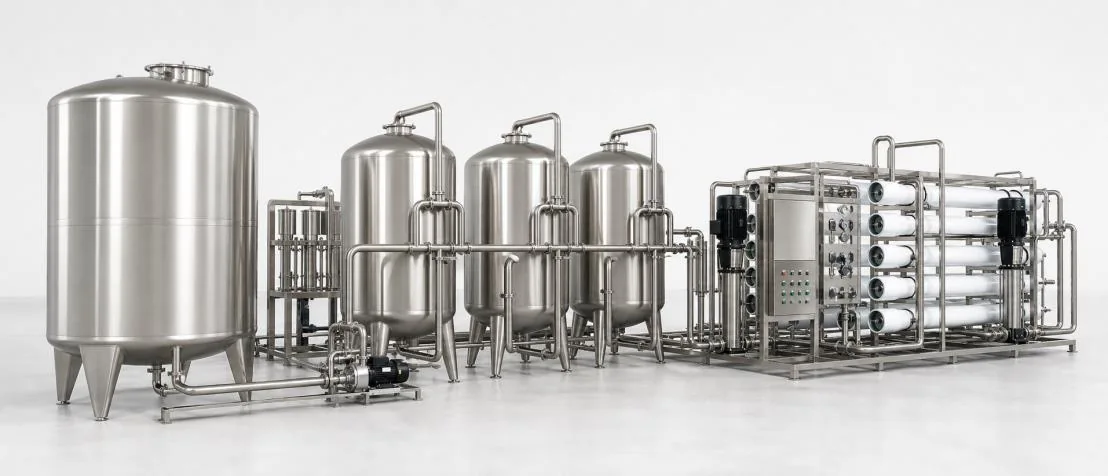
A project may use raw-water storage and pumping, multimedia or mechanical filtration, activated carbon, softening where justified, precision filtration, reverse osmosis or another purification step, UV or ozone, hygienic storage and distribution, then the selected bottle filling and packing route. The actual train follows source analysis, finished-water target, recovery and waste constraints and local requirements.
02 Where it fits
Position in the project journey
Purified-water process definition - after source sampling and before treatment sizing, utility, filling and quality-plan freeze.
03 Buyer inputs
What the buyer should prepare
- Traceable raw-water analysis, sampling conditions and expected variability
- Finished-water specification, product category, market and local approval route
- Production demand, storage philosophy, bottle route and operating schedule
- Available power, feed pressure, drainage, chemicals, labor and wastewater constraints
04 Allot Tech and manufacturing-resource inputs
What should be clarified or provided
- Required removal basis and justified sequence of pretreatment and purification stages
- Design assumptions for feed quality, flow, recovery, waste, cleaning and consumables
- Tank, ozone or UV, distribution, filler-inlet and sanitation interfaces
- Monitoring points, instruments, documents, FAT limits, commissioning needs and exclusions
Allot Tech coordinates requirement, quotation and project communication. Detailed engineering, manufacture, testing, documentation and confirmed service are performed by selected manufacturing resources according to the signed scope.
05 Technical scope
Questions and work to control
Turn the Laboratory Report Into a Treatment Basis
A useful design input identifies the source and sampling point, date, method, units, results and likely variation. Qualified review then connects contaminants or conditions to required removals and pretreatment, rather than treating the words well water or municipal water as a design.
- Traceable and representative sample
- Source variability and operating envelope
- Finished-water targets and local limits
- Open parameters and responsible reviewer
Select Pretreatment Before the Membrane System
The catalog reference includes multimedia or mechanical filtration, activated carbon, sodium-ion exchange and precision filtration before RO. Which steps are needed depends on feed conditions, membrane protection, finished-water target and operating strategy; their presence in a catalog does not make them universal.
- Solids and turbidity control
- Oxidant, organic or odor objectives
- Hardness or scaling assessment
- Cartridge, backwash and chemical interfaces
Define RO and Post-Treatment as One Operating System
Where RO is justified, specify feed and product conditions, recovery assumptions, reject routing, membrane cleaning, instrumentation and response to out-of-spec water. UV, ozone, terminal filtration and hygienic storage need stated purposes and verification rather than decorative inclusion.
- Permeate and reject-water balance
- Membrane cleaning and preservation basis
- Disinfection and contact-system purpose
- Tank, loop and filler-inlet hygiene
Connect Water Release to Bottling Operations
The plant needs a defined decision for releasing treated water to production, handling off-spec results and protecting it during filling. Sampling points, hold states, records, sanitation and line-start conditions should be agreed with qualified quality personnel.
- Routine and compliance sampling points
- Out-of-spec isolation and disposition
- Filler-start and post-cleaning release
- Batch, lot and finished-product traceability
Buyer questions answered
Practical answers before you request a quotation
Does purified water always require reverse osmosis?
Not as a universal rule. Source quality, finished-water target, product definition and qualified review determine the required process.
What information is needed to size an RO system?
Provide representative feed analysis and variation, required product flow and quality, operating schedule, recovery and waste constraints, utilities and cleaning expectations.
Can the catalog treatment diagram be used for construction?
No. It is a Catalog Reference. Project-specific engineering, current equipment, drawings, loads, controls and approved local requirements are needed.
Why does treated-water storage matter?
An inadequately protected tank or distribution path can compromise water after treatment. Define hygiene, venting, circulation, cleaning, sampling and filler interface.
Who confirms that the product meets local requirements?
The buyer, competent authority and qualified laboratory or advisers own the local compliance and product-release route unless a written agreement assigns specific services.
06 Responsibility
Assign the owner before the work is due
Land, building and civil work, permits, import and customs, local taxes, site utilities, unloading, lifting, local labor, travel support and commissioning materials are not automatically included. Confirm every responsibility before order.
07 Common risks
What commonly creates avoidable uncertainty
- A generic RO skid is selected from source type without current analysis
- Feed variability, pretreatment duty or reject-water handling is omitted
- Treated-water storage and distribution reintroduce contamination after purification
08 Acceptance or completion
How to know the stage is complete
The process has a reviewed feed and product basis, named operating limits, hygienic storage and transfer conditions, verified utility and waste interfaces and a qualified sampling and release plan.
09 Required documents
Records that support the decision
- Raw and finished-water specification register
- Treatment process flow and design-assumption schedule
- Utility, chemical, waste and sanitation interface list
- Sampling, commissioning and performance-verification record
Evidence basis
Official references and project limits
These primary sources support the general planning principles used in this guide. The rules, evidence and responsible authority for the actual project country must still be confirmed locally.
Project-specific proposal input
Turn this decision into a reviewable project brief
Share the product, container, target output, destination and available site information. Unknown inputs can remain open for the first review.
10 Next project step
Related guides and next project steps
Share the product, container, target output, destination and available site information. Unknown inputs can remain open for the first review.
Turnkey scope is project-specific and is defined by the signed technical and commercial agreement.