01 Answer first
How should a stable pallet pattern be designed for bottled water?
Start with the approved pack dimensions and strength, pallet and warehouse limits, handling equipment, stack height, route and customer constraints. Compare interlocked and column patterns, layer sheets, top frames and stretch-wrap settings through production, movement and transport trials rather than software geometry alone.
Buyer problem-to-decision map
Questions for Releasing a Stable Pallet Load
Own layer geometry, support, restraint, warehouse and handling stability here; individual-pack testing stays separate.
How should the pallet pattern be selected?
Evaluate pack dimensions and strength, pallet footprint, layer interlock, column alignment, overhang, height, mass and handling limits together.
- Inputs needed
- Pack drawing; pallet; layer count; warehouse height; equipment limits; customer requirements.
- Decision evidence
- Approved pattern drawing and load calculation tied to the saleable pack.
What prevents lower layers from being overloaded?
Model sustained and dynamic load distribution and verify the pack and bottle under representative conditioning and stacking duration.
- Inputs needed
- Layer loads; storage time; humidity and temperature; bottle strength; pack compression data.
- Decision evidence
- Stack assessment and representative compression evidence with defined limits.
Which restraint system should be trialed?
Select stretch wrap, straps, sheets or other restraint from load behavior, pallet quality, handling and destination constraints, then verify settings.
- Inputs needed
- Load geometry; pallet; friction; wrap material; tension; forklift and transport conditions.
- Decision evidence
- Controlled restraint recipe and witnessed handling-stability trial.
How should pallet instability found at startup be contained?
Stop or restrict affected loads, identify traceable boundaries, correct the pattern or process and retest before release.
- Inputs needed
- Affected production; pattern and wrapper settings; materials; warehouse status; inspection route.
- Decision evidence
- Hold record, corrective trial, stability evidence and authorized release.
02 Where it fits
Position in the project journey
Downstream package definition and validation - before material and equipment release.
03 Buyer inputs
What the buyer should prepare
- Approved pack and pallet dimensions and tolerances
- Warehouse, rack, vehicle and customer handling limits
- Stack, route and climate profile
- Damage, lean and movement acceptance criteria
04 Allot Tech and manufacturing-resource inputs
What should be clarified or provided
- Pattern proposal and machine feasibility
- Layer, pallet and stretch-wrap assumptions
- Trial, movement and transport verification plan
Allot Tech coordinates requirement, quotation and project communication. Detailed engineering, manufacture, testing, documentation and confirmed service are performed by selected manufacturing resources according to the signed scope.
05 Technical scope
Questions and work to control
Answer First: Approve a Route-Compatible Pallet Load
Start with the approved pack dimensions and strength, pallet and warehouse limits, handling equipment, stack height, route and customer constraints. Compare interlocked and column patterns, layer sheets, top frames and stretch-wrap settings through production, movement and transport trials rather than software geometry alone.
Define the Decision Boundary
Define pallet type and tolerance, pack orientation, overhang or underhang limits, layers, gross height and mass, compression path, friction and permitted materials. Check every reference pack and degraded but acceptable material condition.
Buyer Inputs for Approve a Route-Compatible Pallet Load
For Bottled-Water Pallet Pattern and Load Stability, first verify Approved pack and pallet dimensions and tolerances and Warehouse, rack, vehicle and customer handling limits. Identify the owner and revision of every input, and keep unknown information visible until evidence closes it.
- Approved pack and pallet dimensions and tolerances
- Warehouse, rack, vehicle and customer handling limits
- Stack, route and climate profile
- Damage, lean and movement acceptance criteria
Connect This Decision to the Complete Plant
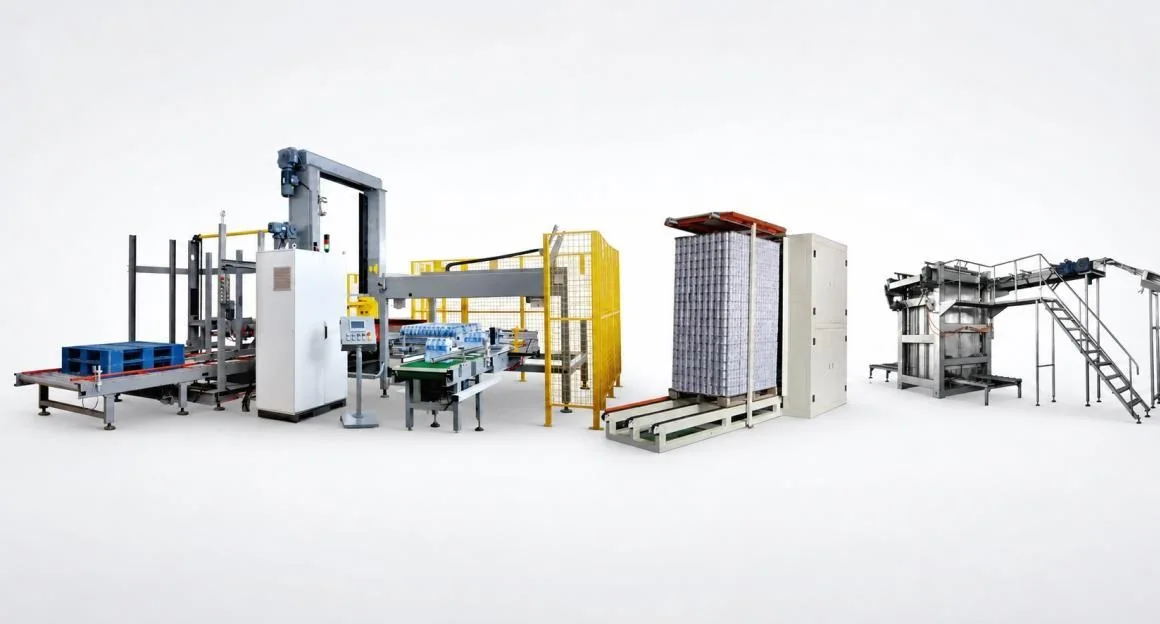
Coordinate pack discharge, palletizer, pallet magazine, layer handling, stretch wrapper, label placement, forklift entry, racking, truck or container loading and customer unloading. Verify stability after realistic dwell and movement.
Responsibility Boundary for Bottled-Water Pallet Pattern and Load Stability
The buyer and material suppliers own approved artwork, component and distribution requirements. Equipment resources must document compatibility, settings, trials, inspection and reject evidence. At the Approve a Route-Compatible Pallet Load gate, require the supplier to document Pattern proposal and machine feasibility, while the buyer owns Stack, route and climate profile and obtains qualified local confirmation where applicable.
- Pattern proposal and machine feasibility
- Layer, pallet and stretch-wrap assumptions
- Trial, movement and transport verification plan
Risks That Can Invalidate Approve a Route-Compatible Pallet Load
A visually acceptable pack at the machine discharge may still fail during accumulation, palletizing, storage or transport. In this decision, pay particular attention to Pattern software ignores pack compression and Stable static loads shift during braking or turning. Record the owner, due gate, action and closure evidence for every risk.
- Pattern software ignores pack compression
- Stable static loads shift during braking or turning
- Pallet variation creates overhang or poor wrapper control
Evidence to Close Approve a Route-Compatible Pallet Load
Close Bottled-Water Pallet Pattern and Load Stability only when Approved pallet pattern and load specification and Pack compression and wrapper trial records are current, reviewable, linked to the project revision, and approved by named decision owners.
- Approved pallet pattern and load specification
- Pack compression and wrapper trial records
- Forklift, warehouse and route observations
- Signed release with controlled settings and change triggers
Next Step: Approve a Route-Compatible Pallet Load
Send the available inputs for Bottled-Water Pallet Pattern and Load Stability, including Approved pack and pallet dimensions and tolerances, for a project-specific interface review. A project-specific review can organize open inputs and interfaces, but final scope, performance, responsibilities and commercial commitments exist only in the signed technical and commercial agreement.
Buyer questions answered
Practical answers before you request a quotation
How should a stable pallet pattern be designed for bottled water?
Start with the approved pack dimensions and strength, pallet and warehouse limits, handling equipment, stack height, route and customer constraints. Compare interlocked and column patterns, layer sheets, top frames and stretch-wrap settings through production, movement and transport trials rather than software geometry alone.
Which buyer inputs should be confirmed for Bottled-Water Pallet Pattern and Load Stability?
Start with Approved pack and pallet dimensions and tolerances and Warehouse, rack, vehicle and customer handling limits. Keep unknowns open until their owners provide evidence.
What evidence should close this decision?
Review Approved pallet pattern and load specification together with Pack compression and wrapper trial records. Signed project documents and qualified local decisions remain controlling.
06 Responsibility
Assign the owner before the work is due
Land, building and civil work, permits, import and customs, local taxes, site utilities, unloading, lifting, local labor, travel support and commissioning materials are not automatically included. Confirm every responsibility before order.
07 Common risks
What commonly creates avoidable uncertainty
- Pattern software ignores pack compression
- Stable static loads shift during braking or turning
- Pallet variation creates overhang or poor wrapper control
08 Acceptance or completion
How to know the stage is complete
Close Bottled-Water Pallet Pattern and Load Stability only when Approved pallet pattern and load specification and Pack compression and wrapper trial records are current, reviewable, linked to the project revision, and approved by named decision owners.
09 Required documents
Records that support the decision
- Approved pallet pattern and load specification
- Pack compression and wrapper trial records
- Forklift, warehouse and route observations
- Signed release with controlled settings and change triggers
Evidence basis
Official references and project limits
These primary sources support the general planning principles used in this guide. The rules, evidence and responsible authority for the actual project country must still be confirmed locally.
10 Next project step
Turn this decision into a reviewable project brief
Share the product, container, target output, destination and available site information. Unknown inputs can remain open for the first review.
Turnkey scope is project-specific and is defined by the signed technical and commercial agreement.